
 Actual Cash Value vs Replacement Cost in Home Insurance
Actual Cash Value vs Replacement Cost in Home Insurance : Buying a home insurance policy is the best way to safeguard your biggest financial investment. However, many homeowners feel completely confused when they look at the fine print of their paperwork. Knowing how your insurance company calculates your payout before a disaster strikes can save you thousands of dollars.
What is Actual Cash Value vs Replacement Cost in Home Insurance?
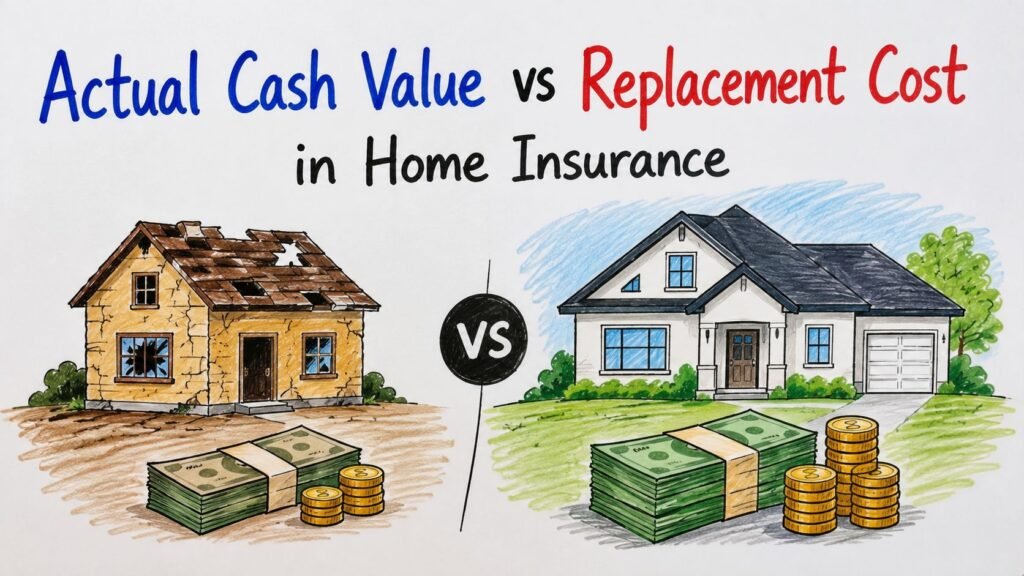
The main difference between Actual Cash Value vs Replacement Cost in Home Insurance comes down to asset aging and wear. Replacement cost covers the full financial expense of buying a brand-new item or rebuilding your house at current market prices. Actual cash value only pays out the item’s current worth after subtracting deductions for age, wear, and tear.
Table of Contents
-
- Deconstructing Replacement Cost Valuation
- Demystifying Actual Cash Value Claims
- The Role of Home Insurance Depreciation
- Real-World Claim Scenarios and Differences
- Key Differences in Property vs Structure Payouts
- Smart Pro Tips for Choosing Your Coverage
- Cost Pitfalls and Common Mistakes to Avoid
- Frequently Asked Questions (FAQs)
Deconstructing Replacement Cost Valuation
When you opt for Replacement Cost Home Insurance for your dwelling structure, you choose peace of mind. This type of coverage ensures that if your house burns down, the insurer pays to rebuild it. The calculation uses modern material costs and labor charges without factoring in how old the house was.
This setup is highly beneficial for the physical structure of your building. If your ten-year-old wooden floors get damaged by a burst water pipe, the insurer pays for new floors. You don’t need to account for how much the wood has lost in value over the past ten years.
Understanding Actual Cash Value Claims
Actual Cash Value Home Insurance bases your claim payment on the property’s value at the time the damage occurs. The insurer generally considers factors such as the property’s age, condition, and normal wear and tear when determining the amount you may receive. works like standard car insurance. The company determines what your item was worth right before the accident happened. This calculation significantly lowers your final check if your items are older.
Most budget-friendly policies default to this model to keep their operational costs low. It saves you money on your monthly bills but can create a massive financial shock during a major crisis. You must cover the remaining balance yourself to get back to a normal life.
The Role of Home Insurance Depreciation
To truly understand how these payouts operate, you must understand the concept of Home Insurance Depreciation. Depreciation is the natural drop in an item’s monetary worth due to regular wear, tear, usage, and age. Every material, from your living room television to your backyard fence, depreciates every single year.
Insurance adjusters use internal life expectancy tables to figure out these exact deduction rates. For instance, if a standard laptop is expected to last five years, it loses twenty percent of its value annually. This hidden calculation is why ACV policies can feel unfair during a crisis.
Real-World Claim Scenarios and Differences
Let us look at a clear practical example involving a major living room electronic item. Imagine a lightning strike destroys your five-year-old television, which originally cost one thousand dollars. Buying a brand-new television with the same specifications today still costs one thousand dollars.
If you have a policy based on Replacement Cost vs Actual Cash Value, your payout varies wildly. An RCV policy cuts you a check for the full one thousand dollars to buy a new television. An ACV policy calculates that the television lost fifty percent of its value over time and pays you only five hundred dollars.
Key Differences in Property vs Structure Payouts
Most standard home insurance plans use a combination of both calculation formats. Your main dwelling structure is usually insured under an RCV setup to ensure you can rebuild your walls. However, your personal belongings inside the rooms are often settled using the ACV vs RCV Home Insurance rule.
If you own high-end items like luxury couches, sound systems, or expensive sports gear, the default ACV coverage is rarely enough. Upgrading your personal property section to an RCV model ensures your belongings get the same high-level protection as your roof.
Smart Pro Tips for Choosing Your Coverage
-
- Create a Home Inventory: Photograph your electronics, furniture, and appliances along with their model serial numbers to prove their initial condition.
- Review Your Roof Guidelines: Many insurance companies change roof coverage from RCV to ACV once the shingles cross fifteen years of age.
- Read the Endorsements: Ask your agent for a “Contents Replacement Cost” rider to upgrade your belongings without changing your entire policy.
Cost Pitfalls and Common Mistakes to Avoid
-
- Focusing Only on Premium Costs: Choosing a cheap ACV policy to save ten dollars a month can cost you thousands later during a fire claim.
- Forgetting About Inflation: Rebuilding costs rise over time due to labor issues. Ensure your replacement cost limits automatically adjust for inflation.
- Misunderstanding Deductibles: Your deductible always applies first. If your ACV payout is eight hundred dollars and your deductible is five hundred, your check will be just three hundred dollars.
Frequently Asked Questions (FAQs)
Q1: Can I upgrade an existing ACV policy to an RCV policy?
Yes, most insurance providers allow you to add an endorsement or rider to upgrade your personal belongings coverage to replacement cost for a slight premium increase.
Yes, most insurance providers allow you to add an endorsement or rider to upgrade your personal belongings coverage to replacement cost for a slight premium increase.
Q2: How do insurers calculate the depreciation on a roof?
Insurers look at the average life expectancy of the roofing material and subtract value based on its age. A twenty-year shingle roof that is ten years old loses half its value.
Insurers look at the average life expectancy of the roofing material and subtract value based on its age. A twenty-year shingle roof that is ten years old loses half its value.
Q3: Is it better to have Actual Cash Value vs Replacement Cost in Home Insurance for old homes?
Replacement cost is highly recommended for older homes because historic materials, plaster walls, and custom woodwork cost significantly more to replicate today.
Replacement cost is highly recommended for older homes because historic materials, plaster walls, and custom woodwork cost significantly more to replicate today.
Q4: Does replacement cost coverage pay for matching undamaged items?
Generally, no. If a fire damages three kitchen cabinets, the company pays to replace those three, even if the new wood does not perfectly match the remaining old cabinets.
Generally, no. If a fire damages three kitchen cabinets, the company pays to replace those three, even if the new wood does not perfectly match the remaining old cabinets.
Q5: What items should always be insured under replacement cost?
Your main home structure, heavy appliances like HVAC systems, refrigerators, and your primary roof should always use replacement cost terms to avoid major out-of-pocket losses.
Your main home structure, heavy appliances like HVAC systems, refrigerators, and your primary roof should always use replacement cost terms to avoid major out-of-pocket losses.
Conclusion
Understanding Actual Cash Value vs Replacement Cost in Home Insurance is the key to avoiding financial surprises after a disaster. Take some time to review your policy documents or make a quick call to your insurance provider today. Investing a little extra money into premium coverage now ensures your family can rebuild comfortably when it matters most!